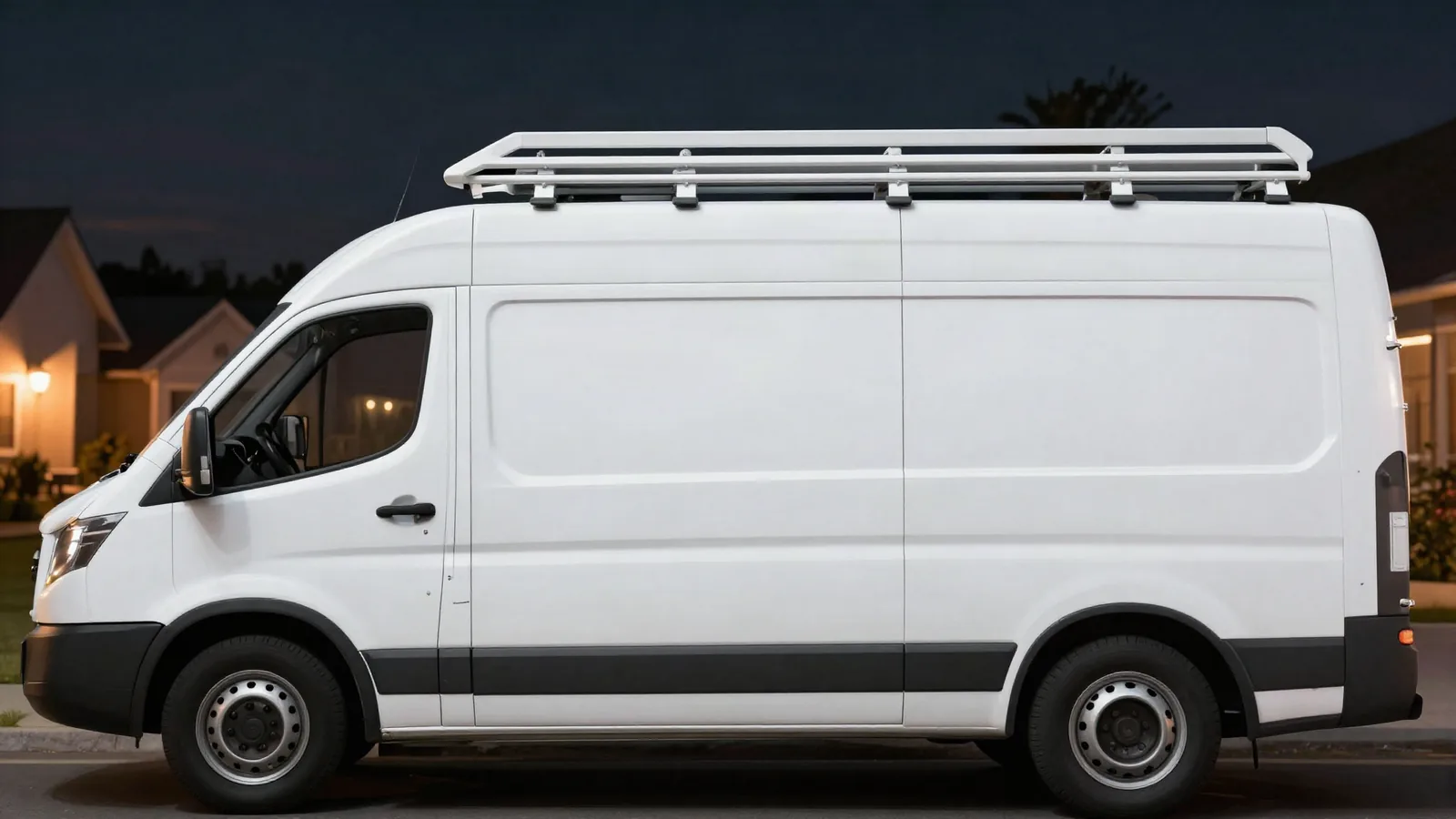
Ask anyone who sells truck wraps whether a wrap is worth it, and you'll hear the same number. One wrapped vehicle gets 30,000 to 70,000 impressions a day. It's on printing company pages, wrap shop pages and marketing blogs. Some say it comes from 3M. Some say the Outdoor Advertising Association of America. Most don't say.
We wanted to know where it comes from before telling a contractor to spend $4,000 on it. So we read 19 pages that quote it, followed the footnotes as far back as they go, and checked 249 wrap shop websites in 16 US and Canadian cities to see what a wrap actually costs.
The Short Answer: a Wrap Probably Pays for Itself, Just Not for the Reason the Stats Give
For most contractors, a wrap or clean lettering on the work truck is probably worth it. The reason is plain math, not the impression count. A $4,000 wrap that lasts five years has to bring in about five jobs at $750 profit each to pay for itself. That's about one job a year from a truck that spends its days in your customers' driveways.
The famous number holds up a lot worse. Of the 19 pages we found quoting it, 10 gave no source at all. The eight that named one named five different organizations, and none of them linked to a document that contains the number. The oldest footnote we could find points to a 2003 study, and we couldn't find a copy of it anywhere.
So the real decision isn't wrap or no wrap. It's whether a full wrap brings in enough extra work to beat lettering that costs about a quarter as much, and whether you can tell the difference. Nobody has published that. Below is how to find out for your own truck.
We Traced “30,000 to 70,000 Impressions a Day” Through 19 Pages. None Linked to the Study.
We ran seven web searches for truck wrap statistics, wrap ROI, impressions per day and the studies behind them, and opened 26 of the pages they returned. 22 could be read. The other four were dead or wouldn't load the article. Of those 22, 19 quote a daily figure in the 30,000 to 70,000 range. Here's who they credit for it:
| Who the page credits for the number | Pages |
|---|---|
| No one | 10 |
| “Industry data” | 1 |
| ARD Ventures | 3 |
| Outdoor Advertising Association of America | 2 |
| 3M | 1 |
| Traffic Audit Bureau | 1 |
| Geopath | 1 |
| Pages that link to a document containing the number | 0 |
Two pages link to an organization's home page, not to a study. One page gives the range as daily impressions in its text and as monthly impressions in its own summary box. Another calls them people, not impressions. When the same number can be daily or monthly, people or impressions, nobody is checking it.
The best trail is 3M's. 3M makes wrap film, so it isn't a neutral source, but at least it footnotes its claims. Its fleet graphics page says vehicle advertising generates 30,000 to 70,000 daily vehicular impressions, and credits “Measuring the Value of Vehicle Wraps” by ARD Ventures, 2003. 3M's 2019 fleet graphics infographic uses 30,000 a day, with the same footnote and a note that the number includes on and off-road impressions. In other words, time parked counts too. A 2016 trade magazine article described ARD Ventures as a venture capital firm. We searched for the study by its title and on the 3M, OAAA and Geopath websites. We found plenty of people quoting it. We never found the study.
The recall number has the same problem. The infographic's 97 percent message recall, against 19 percent for stationary signs, is footnoted to RYP & Becker Group, an ad agency. One trade article dates it to a 2011 case study done for 3M. We couldn't find that study either, so we don't know how many people were asked or what they were shown.
The numbers that come with a published method are smaller, and still useful. In a Morning Consult survey sponsored by the outdoor advertising industry's research foundation, 49 percent of 1,461 adults aged 18 to 64 said they'd noticed advertising on a wrapped vehicle or other signs on a vehicle in the past 30 days. That's real attention. But noticing a truck isn't remembering your name, and remembering your name isn't calling you.
An Impression Isn't a Person, and the Per-Mile Math Varies Six Times Over
An impression sounds like a person who saw your truck. It isn't. Geopath's guide to outdoor ad impressions defines them as a gross count of ad exposures, “including multiple exposures against the same person.” It says plainly that the number is not the unique number of people seeing the ads.
That isn't bad news for a local contractor. Seeing the same truck on your street five times is how a name sticks. Just don't read 30,000 impressions as 30,000 possible customers. If you drive the same loop past the same houses every day, it's a much smaller group of people seeing you a lot.
The daily count itself comes from multiplying miles driven by an assumed number of impressions per mile. Here are the assumptions we found:
- A 1990 Loughborough University report on truck advertising cited US research putting a tractor-trailer at about 101 visual impressions per mile. The same report said that little research had actually been done to assess the precise degree of impact achieved.
- A contractor marketing blog uses 500 per mile and credits the OAAA. It doesn't link to where the OAAA says so.
- A wrap marketplace's online calculator uses 600 per mile.
| Miles driven a day | At 101 per mile (1990 report) | At 500 per mile (blog, credits the OAAA) | At 600 per mile (wrap calculator) |
|---|---|---|---|
| 20 miles | 2,020 | 10,000 | 12,000 |
| 40 miles | 4,040 | 20,000 | 24,000 |
| 80 miles | 8,080 | 40,000 | 48,000 |
That's driving only, with no parked time. Same truck, same road, and the highest assumption gives six times the lowest. A service truck that drives to one job and parks there for the day isn't putting on 80 miles, either.
Now the part that matters for your decision. Work out the cost per thousand impressions on a $4,000 wrap over five years, at 40 miles a day and 250 working days a year. At the lowest assumption it's $0.79. At the highest it's $0.13. Cheap either way. So the impression number doesn't decide anything. It just makes the sales page look good.
One contractor marketing blog takes this further and says wraps cost roughly 100 times less per impression than Google Ads. That compares a glance from a passing car with a click from someone who just typed “furnace repair near me.” They aren't the same thing, and pricing them side by side doesn't tell you which one gets you work.
What Wrap Shops Actually Charge: 34 of 249 Published Any Price
Most articles give a price range without saying where it came from. So we went to the shops. We searched Google's business listings for “vehicle wrap shop” in 12 US cities and 4 Canadian ones, took the top 20 in each, and opened every shop website we could. That was 249 websites. On each one we read the home page and up to seven pages that looked like pricing, FAQ or vehicle pages.
Only 34 of the 249 (13.7 percent) printed a dollar figure for a wrap job anywhere we looked. Just 12 (4.8 percent) printed a price for a full wrap on a pickup, van or truck. Several of the shops that do publish prices are quoting color-change wraps for personal cars, which isn't what a contractor is buying.
| Vehicle | Full-wrap price the shop published | Type of wrap |
|---|---|---|
| Van or truck | $2,500 to $5,000 | Commercial graphics |
| Truck or transit van | $4,500 and up | Commercial graphics |
| Pickup | $3,000 to $5,500 | Commercial graphics |
| Van | $2,200 to $4,000 | Commercial graphics |
| Van | $4,000 to $5,300 | Not stated |
| Any vehicle, printed commercial | About $3,000 and up | Commercial graphics |
| Full-size van | $5,500 and up | Not stated |
| Truck | $4,000 to $6,500 | Not stated |
| SUV or truck | $3,500 to $4,000 | Not stated |
| Truck or SUV | $5,300 average | Color change |
| SUV or truck | $5,500 and up | Color change |
| Pickup truck (Canadian shop) | $2,500 and up | Not stated |
Across the 11 US shops, full-wrap prices for a pickup or van ran from $2,200 at the bottom of one shop's van range to $6,500 at the top of another's truck range. The middle starting price was $4,000. Box trucks run higher. One shop lists $4,900 and up, another $4,000 to $8,000 or more.
Lettering is the cheap end. Shops listed door logos from $300, lettering and partial graphics from $550, and partial wraps on a van or truck at $500 to $1,500, $800 to $1,800, $800 to $2,500 and $1,200 to $1,800.
Two limits on these numbers. We read the pages as plain HTML, so a price drawn in by a script or shown only in a picture wasn't counted, and the real share of shops that publish prices is a bit higher than we found. And a published range is a starting point, not a quote. The design, the vinyl, how much of the truck you cover and removing an old wrap all move the price.
Spending money on a wrap this year? Book a free 20-minute call first. We'll check that the name going on your truck matches your Google profile, and show you what a customer finds when they search it.
Book a Free Profile Check →The Break-Even Math: a $4,000 Wrap Needs About One Job a Year
Forget impressions and ask the question that pays the bills. How many jobs does the wrap have to bring in before it's paid for? Divide what it costs by the gross profit on a typical job.
| What you spend | $300 profit a job | $750 profit a job | $1,500 profit a job | $3,000 profit a job |
|---|---|---|---|---|
| $1,000 (lettering or partial) | 3.3 | 1.3 | less than 1 | less than 1 |
| $2,500 | 8.3 | 3.3 | 1.7 | less than 1 |
| $4,000 (full wrap) | 13.3 | 5.3 | 2.7 | 1.3 |
| $6,000 | 20 | 8 | 4 | 2 |
Those are jobs over the whole life of the wrap. Several wrap sellers say a wrap lasts five to seven years and one says three to seven, so treat five years as a good case, not a promise. At five years, a $4,000 wrap for a trade making $750 a job needs about one job a year. A roofer making $3,000 on a job needs a little over one, total.
That's a low bar, and it's the honest case for a wrap. Not 70,000 impressions a day. One or two jobs a year from people who kept seeing your name in their neighborhood. If your truck spends its days parked at jobs in the area you serve, it doesn't take many of those people to clear it.
A wrap can also cost you. The same 1990 report warned that a product name could be associated with the negative perception of the vehicle it's displayed on. Your phone number on the back of a truck that's tailgating someone is an ad too, just not the kind you wanted.
The Real Decision Is Full Wrap or Clean Lettering
The break-even bar is low for both, so the question that matters is the gap between them. A full wrap at $4,000 costs about $3,000 more than good lettering at $1,000. At $750 a job, the full wrap has to bring in four more jobs over its life than lettering would have.
Maybe it does. A full wrap is easier to notice and looks more established. But we couldn't find anyone, contractor or vendor, who has measured it. Every study we traced counts impressions or recall. None counts jobs.
Whichever you buy, it needs these to work at all:
- Your name, big. The exact name on your Google profile.
- What you do, in two or three words. “Plumbing and drains” beats a slogan.
- One phone number and one web address. Short enough to read at a stoplight.
- Readable from a car length back. A busy photo wrap can bury the name.
If money is tight, lettering now and a full wrap later is a sensible order. And if you run three trucks, lettering all three puts your name in three neighborhoods at once for less than one full wrap.
A Wrap's Real Job Is Getting Your Name Searched
Some people will call straight off the truck. Our view is that more of them see your name a few times and search for it weeks later, when the furnace quits or the roof starts dripping. What they find then decides whether you get the call.
- The name on the truck has to match your Google profile. Google's guidelines say your profile name should reflect your business's real-world name as used on your storefront, website and stationery, and as known to customers. Your truck is part of that real world. If the truck says one name and the profile says another, the person searching what they saw has to work to find you. We covered Google's naming rules in our post on putting a town in your business name.
- The profile they land on has to close the deal. Recent reviews, photos of real jobs, your hours and your service area. A wrap that sends people to a profile with three reviews from 2021 can end up introducing them to the competitor listed next to you.
- The number has to ring you. The simplest setup is the same number that's on your profile.
How to Tell If Your Truck Is Bringing in Work
- Ask every new customer how they heard about you, and write it down. It's free, and it's the only method that catches the customer who saw your truck and then searched your name. Add “Saw your truck” as a choice on your quote form.
- Watch searches for your name. Your Google Business Profile performance report lists the search terms people used to find your business, updated at the start of each month. Note how often your business name shows up for a few months before the wrap and a few months after. Seasons move it too, so compare the same months year over year when you can.
- If you put a separate number on the truck, own it. A second line from your own phone carrier, in your company's name, that you'll keep as long as the truck is on the road. Not a rented tracking number. Rented numbers get recycled when the service is cancelled, and then your truck rings a stranger. We explained that trap in our post on call tracking and SEO, and how to keep control of your numbers in our account ownership checklist.
- Give it a year. If one job a year is the bar, a month of data won't tell you much. Count jobs and revenue, not calls. Here's how to track marketing by revenue instead of cost per lead.
We don't sell wraps. We do manage Google Business Profiles and local SEO for contractors, so we care most about the half of the job that happens after someone sees the truck. Weigh our advice with that in mind.
How we did this: On October 16, 2026 we opened 26 pages returned by seven web searches about wrap statistics, wrap ROI and the studies behind them, and recorded the daily impression figure each one quotes, who it credits and what it links to. 3M's fleet graphics page and 2019 infographic, the 1990 Loughborough report record, Geopath's impressions guide, the March 2023 Morning Consult study and Google's help pages were read the same day. The shop census used Google's Places API text search for “vehicle wrap shop” in Phoenix, Dallas, Atlanta, Denver, Charlotte, Tampa, Seattle, Minneapolis, Columbus, Kansas City, Nashville, Sacramento, Calgary, Vancouver, Toronto and Ottawa, top 20 results each: 319 businesses, 302 with a website, 281 unique websites, 249 that opened. We read the raw HTML of each home page plus up to seven pricing, FAQ or vehicle pages, without running scripts, and coded every price by hand. Keyword Planner shows about 4,400 US and 320 Canadian searches a month for “truck wrap cost.” We don't name the shops or pages, because the point is the pattern, not any one business.